Licence register
Fire industry licences, electrical, working-at-heights, first aid. One record per technician. Expiration alerts 90, 30, and 7 days out.
AS 1851 compliance software built alongside the people who train the industry. Every form, every cycle, every reporting output is keyed to the current standard, the asset in front of your technician, and the owner who signs the annual fire safety statement.
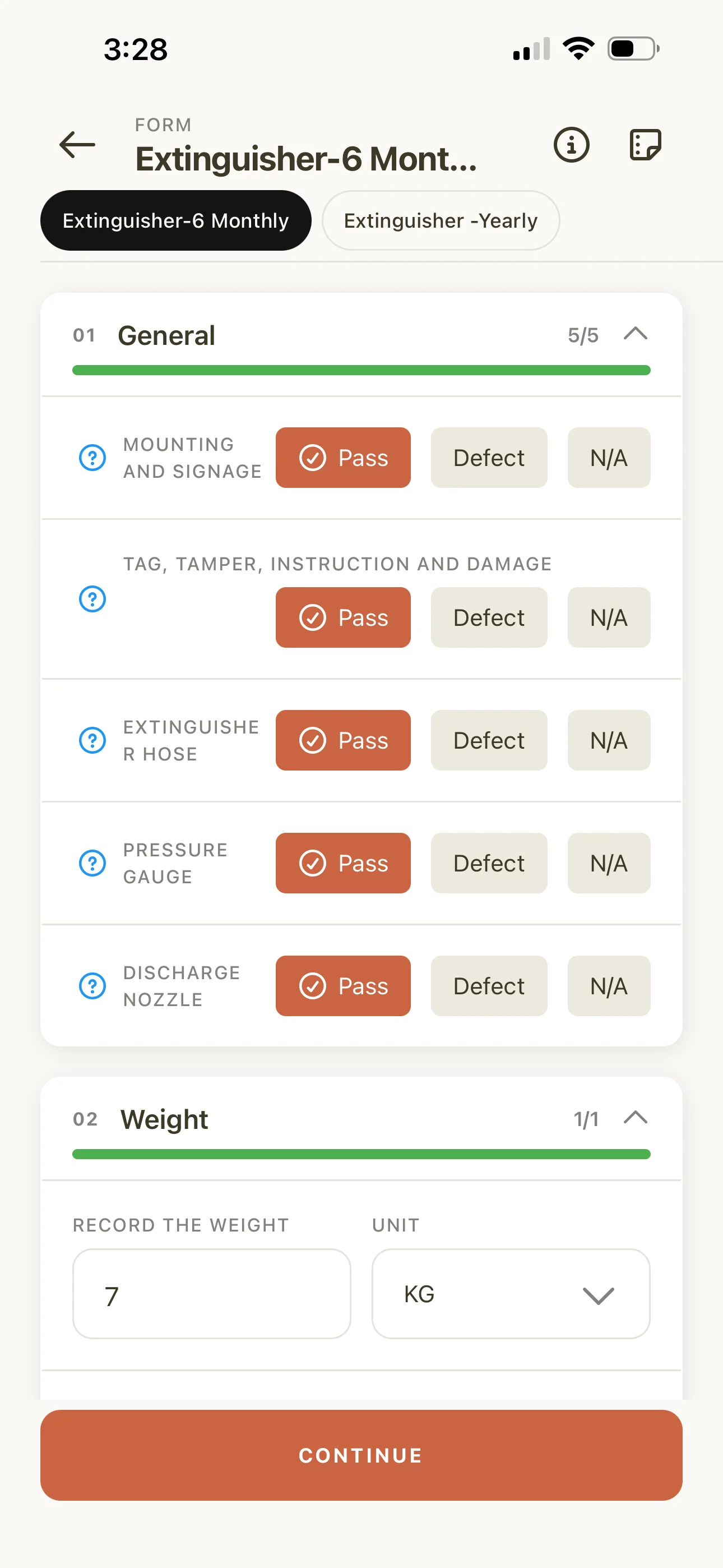
Scan the asset on site and the field app loads the exact AS 1851 form for its type, size, and service cycle. Monthly, six-monthly, annual, five-year. No wrong standard, no missed step. When the standard is revised, your forms update centrally and every technician picks up the new version on next sync.
Your annual fire safety statement is generated from the actual inspection history on the platform, not a separate spreadsheet maintained by one person. The FSA rolls up by site, shows which essential services are current, and flags every defect that remains open before you sign.
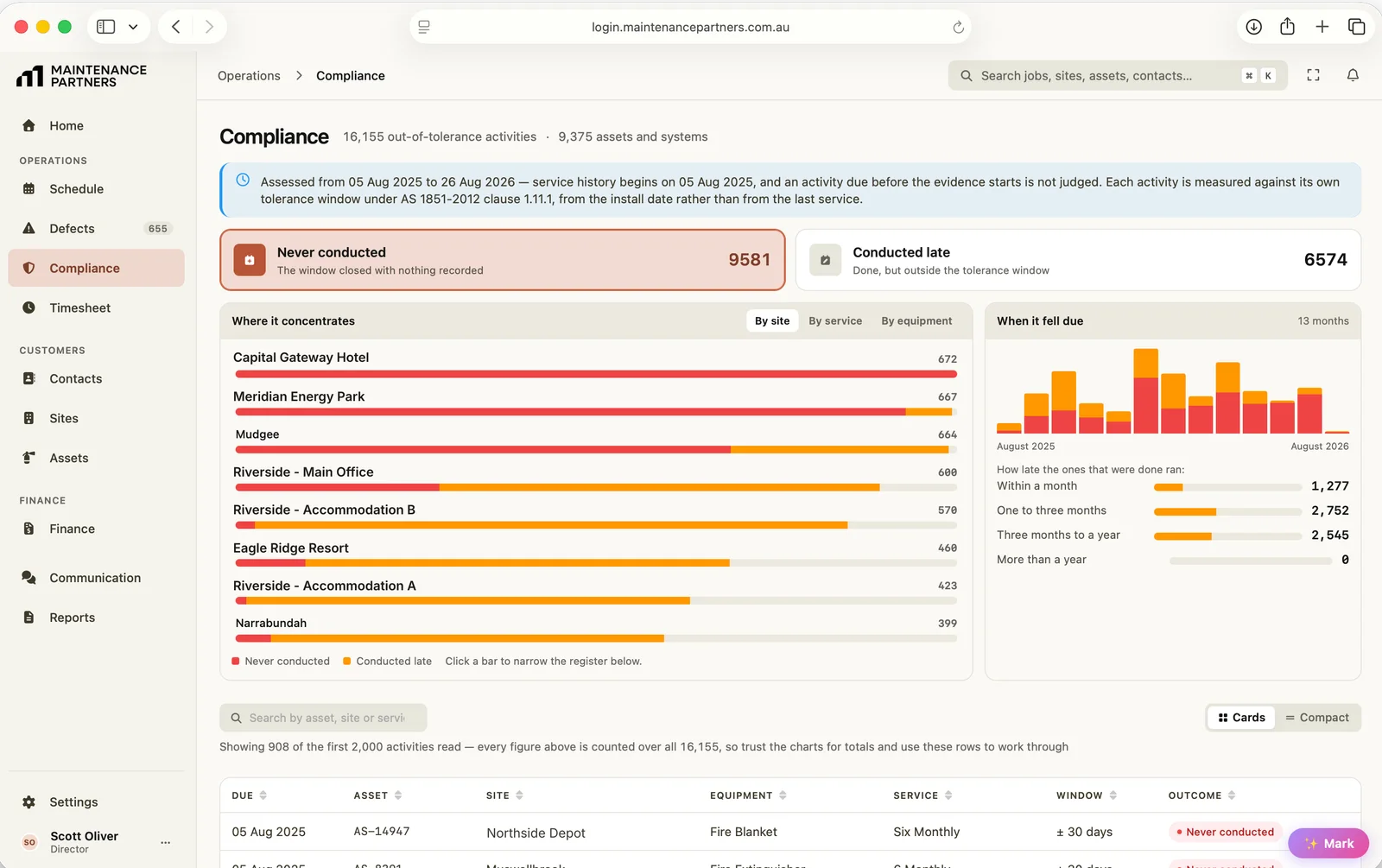
The engine measures every service activity across your buildings against its own AS 1851 tolerance window — and finds the inspections that never happened before an auditor does.
See it on your buildingsEvery technician carries their current licence and competency record on the platform. Scheduling surfaces only the people qualified for the asset type, standard, and class. Expirations are visible months in advance, not the week before an inspection fails.
Fire industry licences, electrical, working-at-heights, first aid. One record per technician. Expiration alerts 90, 30, and 7 days out.
Who can service sprinklers, who can test alarm panels, who holds restricted refrigerant tickets. Recorded per technician, enforced at scheduling time.
Copies of certificates, photos of cards, signed declarations. Audit-ready without a separate HR system.
Site-specific inductions and recurring toolbox talks recorded against the technician and the site. Accessible in the field before the job starts.
AS 1851 is the Australian Standard for the routine service of fire protection systems and equipment. It sets monthly, six-monthly, yearly, and five-yearly service cycles for sprinklers, hydrants, alarms, extinguishers, emergency lighting, and passive systems. Every fire asset in a building requires a service record aligned to the standard.
An Annual Fire Safety Statement is a declaration that every essential fire safety measure in a building has been inspected and is performing to the standard nominated in the building's Fire Safety Schedule. In NSW it must be issued each year and signed by a Competent Fire Safety Practitioner accredited for the relevant measure. Other states have equivalent annual reporting requirements under their respective building or environmental planning legislation.
Property owners must hold a current AFSS or state equivalent, plus the underlying service records under AS 1851 for at least the past 12 months and ideally the asset's full service history. Records include inspection forms, defect notices, remediation evidence, and the competency credentials of the technicians who performed the work. Most regulators expect digital, auditable records that can be produced within a defined response window.
A defect notice is raised when a fire safety measure fails an inspection or no longer meets the relevant standard. Defects are graded by severity—critical, non-critical, or observational—and each grade carries a different remediation timeframe. The owner is responsible for engaging a qualified contractor to rectify the defect, retest the system, and record the close-out before the next AFSS is signed.
Inspection of fire safety measures must be carried out by a Competent Fire Safety Practitioner accredited against the asset class being serviced. Sprinkler, hydrant, alarm, extinguisher, emergency lighting, and passive measures each have distinct qualification pathways. In NSW the Fire Protection Association Australia accreditation scheme is the recognised pathway; other states have aligned equivalents.
Maintenance Partners loads the exact AS 1851 form for the asset in front of the technician, schedules the correct cycle automatically, and flags defects with the standard's severity grades. Annual fire safety statements are generated from the live service record so the report and the underlying evidence stay in sync, and competency rules prevent unqualified technicians being scheduled to inspections they cannot legally sign. It is fire compliance software in the literal sense: the standard is the data model.
Ex GST — $165 inc GST. No setup fees. No lock-in. Volume discounts for larger teams.
Our compliance lead certifies assessors and helps write the training.